Simone de Beauvoir
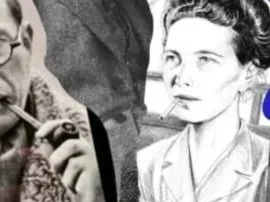
A lot of people have heard of Simone de Beauvoir, often because of her connection with Sartre—sometimes-girlfriend, lifelong companion. This is a bittersweet irony for a woman who railed against the patriarchal society she found herself in. Perhaps she’s best known for her book, The Second Sex, often cited as a founding feminist text. However, she was a brilliant existential thinker in her own right, and her understanding of the ambiguity of freedom is arguably more practical than Sartre’s radical perspective.
The first time I meet her, she comes to a party at my place with Sartre and spends most of the time heckling Hegel. By the time I am deep in the Philippine jungle, she appears more frequently, often alongside other female thinkers and writers like Mary Wollstonecraft, Hannah Arendt, and Émilie du Châtelet. In fact, I watch the news of the burgeoning #MeToo movement with this lot in a reggae bar while they provide the commentary. She is a refreshing antidote to the male-dominated world I am confronted with, acting as a sparky sidekick along the way.