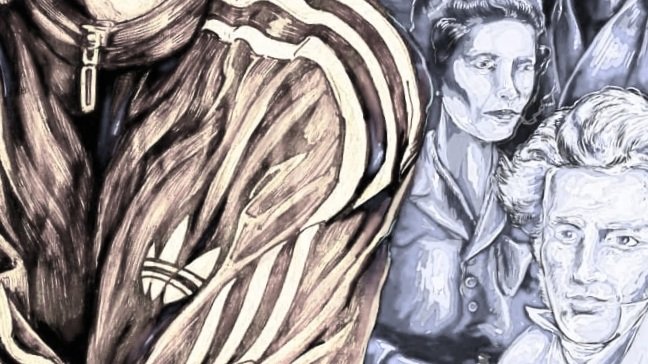
Chapter Nine—Nemesis Part Two
Shit. Back in the castle, in the throne room this time. Hegel was there, kneeling in front of the throne, praying. He was dressed as the king, complete with a flashy crown. To his right was the blackboard with the words ‘Act 3, Scene 4’ highlighted and some other words I couldn’t make out underneath. From behind a curtain on the left, Kierkegaard entered the room in full Elizabethan costume, a sword in his hand. He looked the part alright, whatever part that was. He went behind Hegel, who seemed oblivious to everything, and raised the sword above his head.
‘Now might I do it pat, now he is praying; And now I'll do't;—and so he goes to heaven; and so am I reveng'd’. As usual, the words lit up on the board as he spoke them. Then he turned round and looked at me.
‘So, let us recap. You enter the scene from the left here, come behind Hegel, without making any unwanted noise that may disturb him from his knavish prayers, raise the sword like so and say the words on the board. Then, off with his head. Simple instructions. Direction should indicate not complicate. Your turn’.
He grabbed me by the arm and led me behind the curtain. ‘Right, get on with it’.
I didn’t move.
‘It is very important in life to know when your cue comes, Graham’.
I stayed still.
‘Fine, I will walk you through the scene’. He came behind me and directed me. ‘It is quite straightforward: you enter from behind the curtain, come around him here, raise the sword and then…’
‘Pack it in’.
‘Pack what in, Graham?’
‘I’m not doing it’.
He looked me up and down. ‘Perhaps the problem is you are not dressed for the part. Let me see what I can find’.
He was off in his usual flurry of activity and just about to leave the room when I said, ‘It’s not the clothes’.
He stopped in his tracks. ‘Clothes do not make a man, it is true. Would you like me to go over your motivation again? Perhaps you need to be reminded of it’.
‘Enough with the games, Kierkegaard. Always with the games’.
‘We can dispense with formalities now. Call me Soren’.
‘Alright. I’m not avenging you, Soren. Is that plain enough?’
‘I see. It is just as well that the king does not die in this scene then, is it not? For the hero reasons to himself that “a villain kills my father and for that, I, his sole son, do this same villain send to heaven? O this is hire and salary, not revenge”. So, he leaves the king to his prayers, for what good they do him, and adjourns to his mother’s boudoir, a scene we have previously covered. You will gather by now that time, as your friend Einstein insisted, is relative. After all, it is out of joint’.
‘I haven’t met Einstein yet’.
‘No, but you met a few others, did you not? Including this villain’. He pointed to Hegel, who was still praying, seemingly in another world.
‘Yes, I met him’. I was talking to thin air. He’d done his usual trick of disappearing again, out the door behind the curtain. What if this time, I didn’t follow him.
As if on cue, he stuck his head back through the door. ‘What did he have to say about me?’
Then he was off again. I looked for a moment at Hegel there on his knees. That seemed very out of character for him. This was definitely a dream. The kind of dream Kierkegaard would have, come to think of it. Then I left the room. We were back in the corridor from last time. The Dane was waiting there for me. I noticed he still held the sword.
‘Well?’ he asked.
‘He said you were a fine and upstanding member of the community’.
‘Very amusing. Now who is playing games?’
We started walking. ‘He said you were psychotic. To use Jung’s idea, he basically said you had a complex about him’.
‘Did he? And what do you think?’
‘Don’t ask me. I don’t know what to think anymore’.
‘I suppose he gave you all his bunkum about freedom and the such. I daresay he claimed to have invented me, too’.
I didn’t reply.
‘Along with everyone for that matter. Hegel’s notion of freedom is purely abstract, you understand. That is what makes it so dangerous. In his hands, the “I”, the personal “I” becomes nothing more than a fantastic ventriloquism act in which others are operating our strings. I have done what I can do to accustom people once more to hear an I, a personal I, speak. For truth can only be communicated by an I to an I. As soon as the communication becomes objective, the “we” to the “we”, the truth has become untruth’.
We took the stairs that led up to the ramparts.
‘Who is the I? What is truth?’ I asked.
‘I see you are learning fast on your quest. You did leap, did you not?’
‘I leapt into nothing’.
‘Quite. If one talks of the I as the self, then the self is spirit. Man is spirit. Therefore, man is a synthesis of the infinite and the finite, of the eternal and the temporal, of freedom and necessity. A synthesis is a relation between two factors. So regarded, man is not yet a self’.
‘That sounds like Hegel. It’s got that same gobbledygook stroke smarty-pants feel’.
He laughed. ‘That was the intention of the author, Anti-Climacus’.
‘One of your pseudonyms?’
‘Indeed. He was poking fun at Hegel’s language, though the joke was lost on most. The point is: there is a delicate balancing act being played out in everyman and woman’s life—between these dialectical opposites—and we are the relation, to the equilibrium or lack of it. Hegel was wrong; these opposites are not neatly resolved; there is a constant tension between the pull of these apparent paradoxes. We are, therefore, becoming the I, Graham. One is not yet a self. The leap, et cetera, et cetera. With regard to truth, two things about that. One: it can only be appropriated subjectively, by the I, though that does not presuppose that it cannot be objective in nature, merely that objective truth is always uncertain until it is appropriated subjectively—out on the deep over seventy thousand fathoms. Two: the truth is a trap; you cannot get it without it getting you; you cannot get the truth by capturing it, only by its capturing you. That is why sometimes it is necessary to deceive people into the truth’.
By this time, we were on top of the ramparts once again.
‘Is that what you’ve been trying to do with me?’ I demanded. ‘Swapping roles all the time. First, the ghost, then the king, now Hamlet’.
‘That was one of the purposes of the pseudonyms. When you label me—’
‘—you negate me. Yes, I get that’.
‘Now, it is time to fence. Literally as well as metaphorically. Pick up your sword’. He gestured to the wall where a sword leaned against it.
‘What?’
‘I know you have questions. I will only answer them if you use your weapon. Actions speak louder than words, after all’.
‘Paul said that as well. Which reminds me. Paul said I should ask you about the thorn. You used that word a lot, didn’t you? What was your thorn, Soren?’
‘Sword’. He gestured to it again.
‘Alright, alright. I’ll play. When in...Elsinore and all that’. I picked it up, which was just as well because he didn’t hang about. He thrust straight at me, and I only just managed to get out of the way of the blade. ‘Bloody hell. I thought we were just playing’.
‘You thought wrong, sir. If people are still writing books concerning the nature of my thorn, which they do with evermore tedium, why in heaven do you think I would tell an upstart such as yourself?’
‘Fine. It was Regine then, wasn’t it? When you broke off the engagement, you gave up on being normal like everybody else. You gave up on reality and escaped into fantasy, into “infinitude”, as you put it. You made her an object of that. She became an idea, a muse, because ultimately, that’s all you could handle, you coward. And you held onto that idea for the rest of your life, avoiding the real, finite, world. The one where you broke the girl’s heart. She was a thorn in the flesh to remind you of your lack of faith’. I jabbed at him, but he saw it coming and deftly jumped to his left.
‘You will have to do better than that’, he said. ‘Remember, I was something of a psychologist myself. When one thinks about it, perhaps Hamlet treats Ophelia in a similar fashion, with the supreme irony that it is Ophelia who cannot escape the fantasy that Hamlet has projected onto her. At any rate, he did “importune her with love, in honourable fashion” only to declare to her later “I loved you not”, a trick of the heart that I myself employed once. Though like Ophelia, I do believe poor Regine never really fell for it. Fortunately, however, she did avoid the same tragic end. That would have been too much to bear’. He stood still for a moment thinking about this. I saw my chance and lunged—into the wall behind him. ‘It is only an interpretation’, he continued nonchalantly, ‘Not bad though, if I say so myself. Is that all you’ve got, you scoundrel? You are a bit rusty at this lark, I can see’.
‘What about your melancholy then? You called it “sweet melancholy” in your journals. I think you identified so much with being depressed that, in the end, you didn’t want to let go of it. You liked it too much. You didn’t want to get better. It legitimised you’. I thrust, but once again I was too slow. ‘Your technique is clumsy, lacks finesse. But practice makes perfect’. He gestured for me to try again.
‘OK, how about the “great earthquake”? That’s when you came to think there was a curse on your family, wasn’t it? That God had somehow cursed your family because of something your father had done. Five of your six brothers and sisters died young, right? So, is that it? You could never shake the thought that you were somehow born to suffer’. This time he parried me, then our swords locked, and we grappled with each other face-to-face.
‘Congratulations, you have done your research. Very thorough. Anymore?’
‘Maybe you were ill. Syphilis? Epilepsy?’ He pushed me away, and I fell to the floor. He circled me as I desperately struggled to get to my feet. ‘I had a sickness. A sickness unto death. Just like you’.
‘What?’
‘Despair, Graham. That was my sickness: quiet despair’.
‘I don’t know what you’re talking about’.
‘Au contraire, you know exactly what I am talking about’.
By now I was back on my feet. He started to swish his sword through the air with confident strokes, getting ready to lunge at me. ‘The formula for all despair, as Anti-Climacus states in his book The Sickness unto Death, is to despair over oneself. That is to say, to will to be rid of oneself. All this talk of nihilism, Graham’. He started walking towards me and then struck at me, but I managed to block him.
‘What of it?’ I replied.
‘To will to be rid of oneself. All the self-piteous whining about not wanting to write, or not being able to write. Whatever’. He struck again, more viciously this time, and I only just managed to counter it.
‘It’s true’, I exclaimed.
‘To will to be rid of oneself. Your refusal to embrace your destiny: to become an existential believer. To will to be rid of oneself’. Another blow. I blocked, but I was retreating all the time and getting dangerously close to the edge of the castle walls.
‘I leapt off the wall’.
‘You leapt once. But you have to keep leaping. That’s how the narrative unfolds. To close the gap between what you want and what you end up with’.
‘More flipping grief’.
He continued, ‘And while we are on the subject. I see no ring on your finger. Where is your wife? All I see is a man with a thorn in his flesh. It takes one to know one, after all’. He jabbed at me, and with one quick flick of his wrist knocked my sword out of my hands. He placed his blade on my chest. ‘How appropriate. Your back seems to be against the wall’. That was about the size of it, to be fair. ‘You’ve accused me of holding on to suffering’.
‘You said to believe is to suffer. You martyred yourself with it. Look at The Corsair Affair’.
‘You think Paul cursed me then?’
‘I think Paul cursed Christianity’.
‘Then there’s only one thing for it’. He put his sword up to my neck and ran the point along my throat. ‘Actions speak louder than words. Up, up’. He gestured for me to climb the castle walls. I got up and stood looking towards the sea. Then I looked down. The tide was in, but there were rocks, too. Lots of them. ‘By the way, if you make it, find Derrida. He should be in the final act’.
‘What’s so impor—?’
Then he pushed me off the wall.