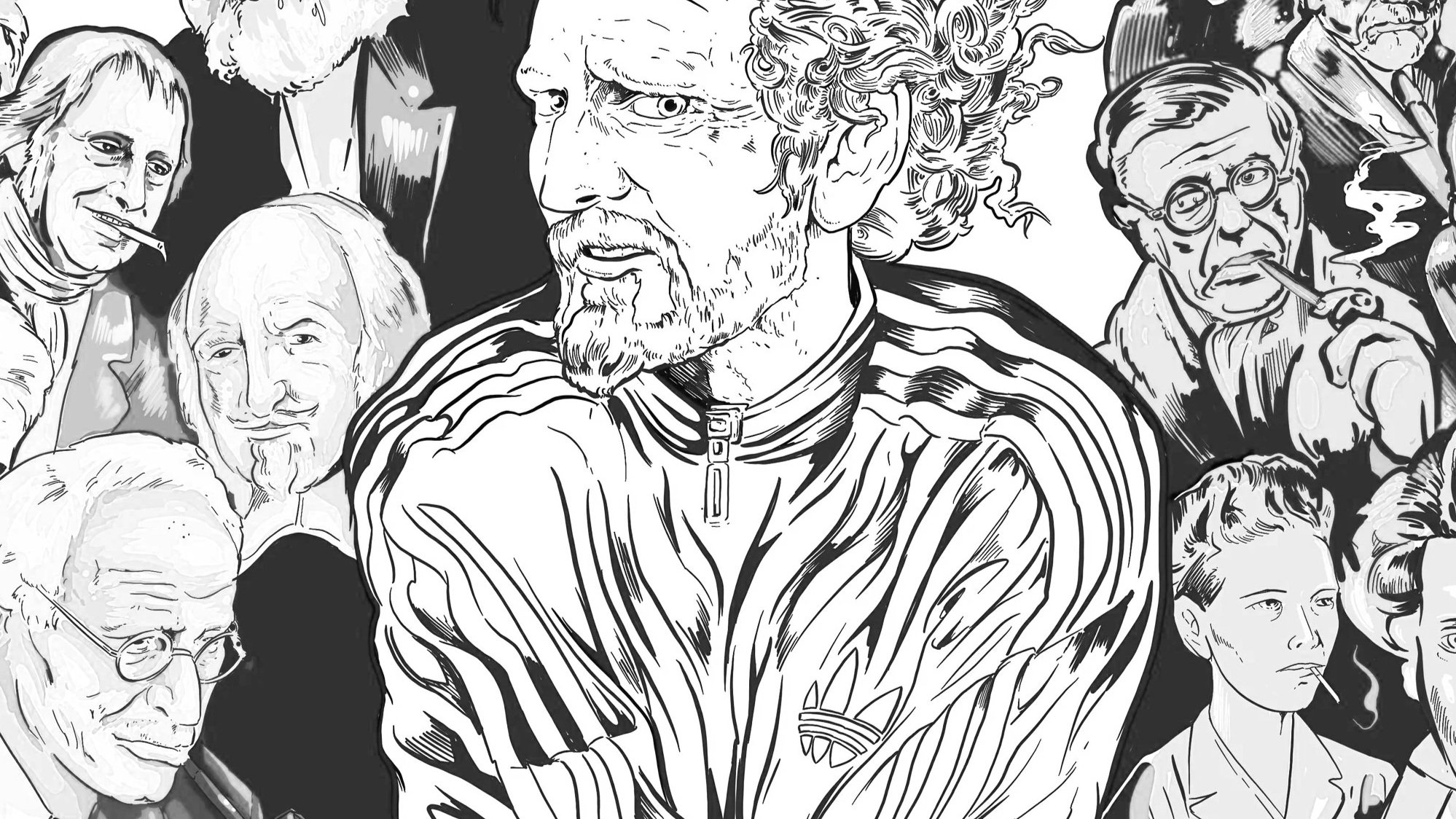
Chapter Eight—Nemesis Part One
There was a knock at the door. I knew that knock. It wasn’t the rozzers or the bailiffs. Actually, I hadn’t heard it for a bit. Things had been quiet on that front—no visitors, no dreams. As I walked down the stairs, I felt a little tingle of excitement mixed with a dose of anxiety at the thought of who Hobbes had brought round this time. There wasn’t much I could do to stop all this now. It had its own momentum, whatever “it” was. What with the shrinks, Nishida, the writer’s block, and everything else—well, reality used to be a friend of mine. Past tense, clearly. Besides, I did leap off the castle; maybe I was complicit. With all this going through my mind, I opened the door.
‘Ah, my dear boy’.
‘Your usual No. 21, Thomas’.
‘Indeed. We were in the vicinity. I hope you don’t mind’.
The front drive was packed with loads of them, and some women this time, I noticed.
‘You’d better come in’.
They filed into the house, a right ole’ hodgepodge this time, for sure. I recognised Sartre, who had an attractive woman on either arm. He gave me a warm smile and went on out the back. Lacan was here too. He gave me a brief nod and stood where he did last time by the fireplace as though he owned it. I didn’t recognise any of the others except for one guy in his fifties or so who looked vaguely familiar. As for everyone else, one or two were dressed like Hobbes, from around that time anyway. Some looked like they’d stepped straight out of the French revolution. One or two were all done-up in black with roll necks and berets. A whole group looked like proper eggheads, university professors maybe, wearing shirts, ties and jackets with leather patches on the arms. They all looked a bit dishevelled, apart from one—a bald-headed chap sporting a natty-looking beige roll neck with his jacket. They all wore glasses, and most of them had pipes or some kind of tobacco hanging from their lips. They were like some sort of weird geeky egghead club.
‘You better go into the garden. There’s more space there’.
‘Merci, my friend. Perhaps you have some music we can play. I can DJ’. This was one of the revolutionaries— a jovial sort of around 30 sporting a powdered wig doing its best to escape his head. He looked like he’d already had a few.
‘Allow me to introduce myself. My name is Voltaire. Perhaps you ‘av ‘urd of me?’
‘Voltaire. Yes, you were something to do with the French revolution, right? You certainly look the part’.
‘Ha-ha. Modesty forbids...’
‘Modesty has never forbid you’. This was another Frenchie who looked Voltaire’s twin, except he was impeccably dressed.
‘And it never will. You are an enemy to modesty or any other quality of virtue’.
‘Ach, go hang, Rousseau, with your bilious arse’. Voltaire made a gesture, as if he was trying to get rid of a bad smell. ‘Watch this one, Grahm. He will bore the very breeches from off your legs and charge you for the privilege’.
‘Libelous fool. I am Jean-Jacques Rousseau, Monsieur. Perhaps I can claim to have had no little influence on the revolution eye-the. Perhaps you have heard of me too, n’est-ce pas?’
‘Err...kind of’.
Voltaire looked triumphant. Rousseau looked wounded and embarrassed. Fortunately, Hobbes came to the rescue.
‘Gentlemen, please, you are keeping the host from his guests’.
‘I apologise profusely, ‘Obbes. I shall see to the music, with your permission, of course, Gray-ham’.
‘Go ahead, put on what you want’.
We moved to the garden, where the party was already in full effect. They’d grouped themselves into little cliques. The shirt-and-tie brigade sat round the table in heated discussion, drinking red wine and puffing on their pipes and cigarettes. Lacan had come out and joined them. A group of women were gathered near the shed, giggling conspiratorially. And in the corner, some of the Hobbes look-alikes and revolutionaries were busy trying to figure out how to work my spanking new top-of-the-range barbeque from B&Q. One of them was on fire.
‘Let me do my best to make sense of this rabble for you’.
‘Yes, do, Thomas, I feel like I’ve gate-crashed my own party’.
‘Indeed. I thought it wise to bring over a few Frenchies this time. There were complaints that the German-speakers were hogging the limelight, so to speak’.
‘Complaints? From whom?’
‘From the others’.
‘And how many others are there?’
‘A goodly size. You have caused something of a stir’.
He could see I was keen to find out exactly who these ‘others’ were, but he cut me off before I had the chance to ask.
‘Let us not dwell on that for now. There are more pertinent matters at hand. Where do I begin? The ones around the table are the more modern types, or post-modern, to be precise. As a general rule, anyway. Language and meaning, or the lack of it, is primarily their bag, along with culture and the such. I thought they might be of some use for you in your...adventure’.
‘Lacan been speaking to you, has he?’
He ignored the question.
‘The girls, now they are a splendid assortment, are they not?’
‘They are that, Thomas’.
‘The one with the big dress and wig, of fair complexion and thirty years maybe, that is the Marquise du Châtelet. She is the mistress of Voltaire’.
‘Is that so?’
‘So I have on good authority. She is quite a character. She is a brilliant scientist and is responsible for several discoveries that have furthered the subject, including predicting infrared radiation and identifying the relationship between energy and velocity. Two centuries before Einstein, I should add’.
‘Wow’.
‘Indeed. She has also translated Newton’s Principia Mathematica into French, which is no mean feat. I believe her translation is still the standard issue employed. She and Voltaire spent years together at her chateaux in the north of France, carrying out scientific experiments and whatnot. The woman she is talking to is Simone de Beauvoir’.
He pointed to an elegantly dressed lady in her mid-thirties.
‘She’s quite striking. I’ve heard of her’.
‘She is perhaps most famous for being Sartre’s girlfriend, which is certainly unfortunate, for she is one of the first modern day feminists. An existential feminist, no less. The group by the cooking apparatus are mostly from the Enlightenment, the so-called Age of Reason. That is why they are so fascinated by your technological device. It is flies to cow dung’.
‘Who are the two fellas standing on their own near them? They look a bit shy, but I see they’re both interested in how the barbeque works. They’re wearing the same kind of get-up as you’.
‘The young-looking one on the left is Blaise Pascal, born 1623, died 1662, at the age of only thirty-nine. He is the inventor of the first mechanical calculator. He also has a triangle and a computer language named after him. A brilliant mathematician; a child prodigy, by all accounts’.
‘Rings a bell’.
‘Kierkegaard is a big fan of the boy. They have a lot in common. Apropos the other loner, the older one, that, my lad, is one Rene Descartes, old cogito himself. I think—’
‘—therefore I am. I know that one. That’s him, is it? Check that out’.
‘Never cared for him myself, you understand’.
‘You knew him? Or know him? I’m still not sure how that one works’.
‘Do not concern yourself with the matter. Yes, born 1596. Died 1650. He and I are the oldest ones here. However, I am his senior, by dint of eight years, so he can go hang, as you so eloquently put it. On the one occasion we met, I found him an arrogant sort; totally convinced by his own argument that, somehow, he had proved the existence of everything, starting from himself. I suppose one could argue he is the grandfather of the Age of Reason in some ways; a complete rationalist, you see. We did not see eye-to-eye on a few matters—the whole mind-body dualism pre-occupation? Hogwash! He should have stuck to geometry. He was good at that. Moving on, you see the gentleman on fire?’
‘Yes’.
‘That is his prodigy, of a fashion, and Kierkegaard’s nemesis’.
‘What, that’s Hegel?’ He was the man I’d clocked before but hadn’t been able to place, currently trying desperately to put out the fire on his arm whilst attempting to look completely in control of the situation.
‘Yes, George WF Hegel. The only German here; quite able to fend for himself mind, as you will see. A beardless German, you’ll note. It seemed the right time for you to meet him’.
‘Shouldn’t we help him? He’s on fire’.
‘The man who is responsible for arguably the most comprehensive philosophical attempt to explain everything— and I say that as one who is not shy in this regard—should be able to work out how to extinguish a fire on his sleeve, don’t you think?’
We watched as one of the Enlightenment crowd reluctantly sprayed him with the garden hose.
‘How very apt. The man responsible for arguably the most comprehensive scientific attempt to explain everything—or one of them, certainly—has discovered how to extinguish the fire’.
‘Err...is that Newton?’
‘Well done’.
‘Bloody hell!’
‘Quite ironic. Hegel is a stern critic of him, you know. The gentleman watching on is John Locke, a contemporary of mine and good friend of Newton. Like myself, he has a hankering for political philosophy with views on how societies are established and governed, though we differ on a few important points. My view on human nature is more pessimistic than his, for one’.
‘What, you think we’re all selfish bastards?’
‘Yes. Don’t you?’
I laughed.
‘Pretty much, yeah’.
‘Locke is a little more forgiving on the matter, though not quite the unblinkered romantic Rousseau is. According to Jean-Jacques, we are all by nature saints, not sinners. A rather quaint thought that one or two other revolutionary types have believed. Look where it got them, I say. Anyway, that’s the British contingent, along with your good self, of course. But enough of such larks, I believe it is time to call this meeting to a start’.
With that, he bounded into the crowd.
‘Ladies, gentlemen, we are ready to begin the proceedings’.
I really hoped he wasn’t going to put me on the spot.
‘Graham, do you have a question for your guests?’
I should have known. Everybody looked at me expectantly.
‘Hmm, hello everyone. Make yourselves at home’.
‘Be careful what you say, Graham. You might have difficulties getting rid of some these reprobates’.
There was general laughter.
‘Err...OK I guess there is one question I could ask’.
Hobbes gestured at me to get on with it.
‘Why does Kierkegaard hate Hegel so much?’
It seemed the obvious question, given the company. The place erupted. There were cheers and general backslapping. One of the shirt and tie brigade knocked over a bottle of wine in the furore, and several handed over money to others.
‘I told you, Sartre!’ Hegel exclaimed.
Sartre gave him some money, shrugged his shoulders at me, and returned to his spot by the French windows that led back into the house.
‘Because that man hates people, vare-as I love them’.
More laughter.
‘Zer idee of people. Nuffing more’, Sartre replied.
‘My dear gentlemen, ladies, my philosophy is the philosophy of both the many individual vills, the I that is Georg Wilhelm Friedrich Hegel—’
‘—a cur-sed I’, chipped in someone from the crowd.
‘—and the collective vill—the vee, the whole, the community, society, and the state. The one! Kierkegaard detests the people. He dismisses them as the “crowd”, the ‘”public”, the “masses”. He only cares about the individual. Me, I care about everyone. Mine is a philosophy of mutual recognition, his is a philosophy of isolation. I do believe, at length, the only person he cares about is himself. That subject fascinates him infinitely’.
There were cries of ‘shame, shame’ at this. Hegel, however, carried on without batting an eyelid.
‘My boy, do not be fooled by that man. Votever he is telling you about me, his opinion is, how am I saying, flawed. I sink his failure to attract an audience for his vurk, married to his deep psychological issues and the vay the people are turning on him during The Corsair Affair, all this drove the poor fellow into a state of derangement, of psychosis even. And I somehow became the object for this. Probably because I had everything he did not. Like an audience, for one. But I assure you, Grar-ham, I am no more responsible for all the evils he is ascribing me than I am for all the evils anyone else is ascribing me. And they ascribe much!’
‘Le destroyer of philosophy’, shouted someone sitting at the table.
‘Le dialectic of nonsense’, shouted another.
‘Le father of totalitarianism’, ‘le slayer of history’, ‘capitalist pig’, the accusations started to come thick and fast, most of them seemed from the shirt and tie lot.
‘L’arrogance of reason’, Pascal said.
‘Le naiveté of idealism’, Sartre exhaled on his cigarette.
‘See?’ Hegel exclaimed triumphantly.
‘L’ami de Rousseau’, Voltaire said as he staggered through the French windows, nearly falling flat on his face. Everybody laughed except Rousseau, who just glared at him.
‘A complete philistine concerning the understanding of natural science and the empirical method’, Newton suddenly piped up, which killed the atmosphere somewhat.
‘What’s that exactly?’ I whispered loudly to Hobbes.
‘Any procedure for conducting an investigation that relies upon experimentation and systematic observation rather than theoretical speculation. The term is sometimes used as a vague synonym for the scientific method’.
‘Right’.
‘You derived your conclusions from your experiences, and in physics and the theory of colour-vision, you made bad observations and drew worse conclusions’, Hegel said to him dismissively.
Madame du Châtelet responded, ‘Oh, come, come, monsieur, you are too harsh, I think’.
‘This Newton, like all the physicists, with the exception of you, madam, indeed never learned. He is not knowing that he sought in, and had to deal with, notions and ideas vile he imagined he voz dealing viv physical facts’.
‘I beg to differ’, Descartes remarked casually.
Hobbes took up the baton, ‘Yes, steady on Hegel. That is an extremely broad brush you are using to tar the empirical method with’.
‘I apologise, gentlemen. I meant no offense, but you ver both mathematicians, first and foremost. Along viv being first-rate philosophers’.
‘I invented calculus’, Newton said, quietly seething.
‘Did you, Newton? I believe Leibniz has somesing to say about that’, Hegel snapped back.
‘I should have left you to burn, impudent oaf’, Newton retorted.
Then Locke got involved, ‘Leave him be, Isaac. The man’s disdain for British philosophy is but the utterings of a German idealist buffoon’. This only seemed to encourage the man.
‘To the English, philosophy has ever signified the deduction of experiences from observations. This has, in a one-sided vay, been applied to just about everysing. All matters which rest on sinking experience—the knowledge of votever reveals itself in this sphere as necessary and useful—signifies philosophy to the English. The scholastic method, healthy amongst the French, of starting from principles and definitions, you are rejecting. The universal—laws, forces, universal matter, et cetera—have, in natural science, been derived from perceptions, and the senses—the so-called empirical method; thus, to the English, Newton is held to be the philosopher par excellence. Or should that be: the philosopher par ignorance’.
Newton might well have lynched Hegel at this point had not Locke held him back. The French, on the other hand, were loving it, positively egging him on with cries of ‘vive Hegel’.
‘Now, now, Georg, we British don’t take too kindly to that sort of thing. Need I remind you of where exactly you are’, Hobbes said firmly. Hegel looked at me and gestured apologetically.
‘Of course. My joke voz in poor taste. I apologise to you, Newton. I am meaning no harm. It is a fact that I have alvays had something of a frosty reception amongst the British. My reception on continental Europe has alvays been more...enthusiastic. I suspect my views on your empirical traditions is not helping in this’.
Hobbes diplomatically took over again. ‘Perhaps another question, Graham?’
‘OK’.
I was beginning to enjoy myself. Hegel was an arrogant son-of-a-bitch, for sure, but he put up a good fight.
‘So, Kierkegaard went on about how you are responsible for the masses trampling on the individual, conformity, and everybody thinking the same. Unfreedom, he called it. You disagree, then?’
‘My philosophy is firstly a philosophy of freedom, for the History of the vurld is nah-sing other than the progress of the idea of Freedom. Grar-ham, shall I tell you an irony which is often overlooked by the existential types? They all owe me a debt. I am giving them the language they speak in—"being”, “nah-sing”, “becoming”, “the Other”—you have heard them use these? The Greeks may have introduced them into the lexicon of philosophy, but I rooted them into the lexicon of the individual, and the existence of the individual self. That is, a becoming, developing conscious self. The self-consciousness of the spirit. Is it chance that Sartre wrote a book called Being and Nah-singness? I sink not. Kierkegaard voz no different. He talks of dread, anxiety, fear and trembling—when the individual is confronted by his or her own freedom. He is also talking about the loss of this freedom through the temporality of life, by death. I am writing about such sings. He vote a book called the Concept of Dread. Is that by chance? And then the Nazi, Heidegger, is stealing from him and called it Angst, but it is the same. Where do you sink they got that from? Ask them. Ask them about my concept of the Lord and the Bondsmen. You can also ask Heidegger about Dasein. That is my Geist, my Absolute Spirit. And ask Nietzsche. He wrote about the morality of the master and the slave. His Übermensch, superman, is also my Geist, and he is stealing the phrase “The Death of God” from me. Ask them all from where they got their language, their inspiration, even their method—the method of the dialectic, vich they all appropriate in some vay. To be brief, I am the true grandfather of the existential—of concerned viv the problem of existing, of being. They are all my bastard offspring. I, Georg Friedrich Wilhelm Hegel’.
When he had finished, the place erupted into chaos. Some clapped, some cheered, some started fighting with each other, some tried to start fighting Hegel, though he somehow avoided all the mayhem around him. It took a while for things to settle back down, but when they did the first person to speak was Sartre.